Got your eye on the Sunshine State?
Florida is unlike anywhere else and our insurance is no exception.
Whether you’re looking to make a move or lucky enough to already live here,
we make it easy.
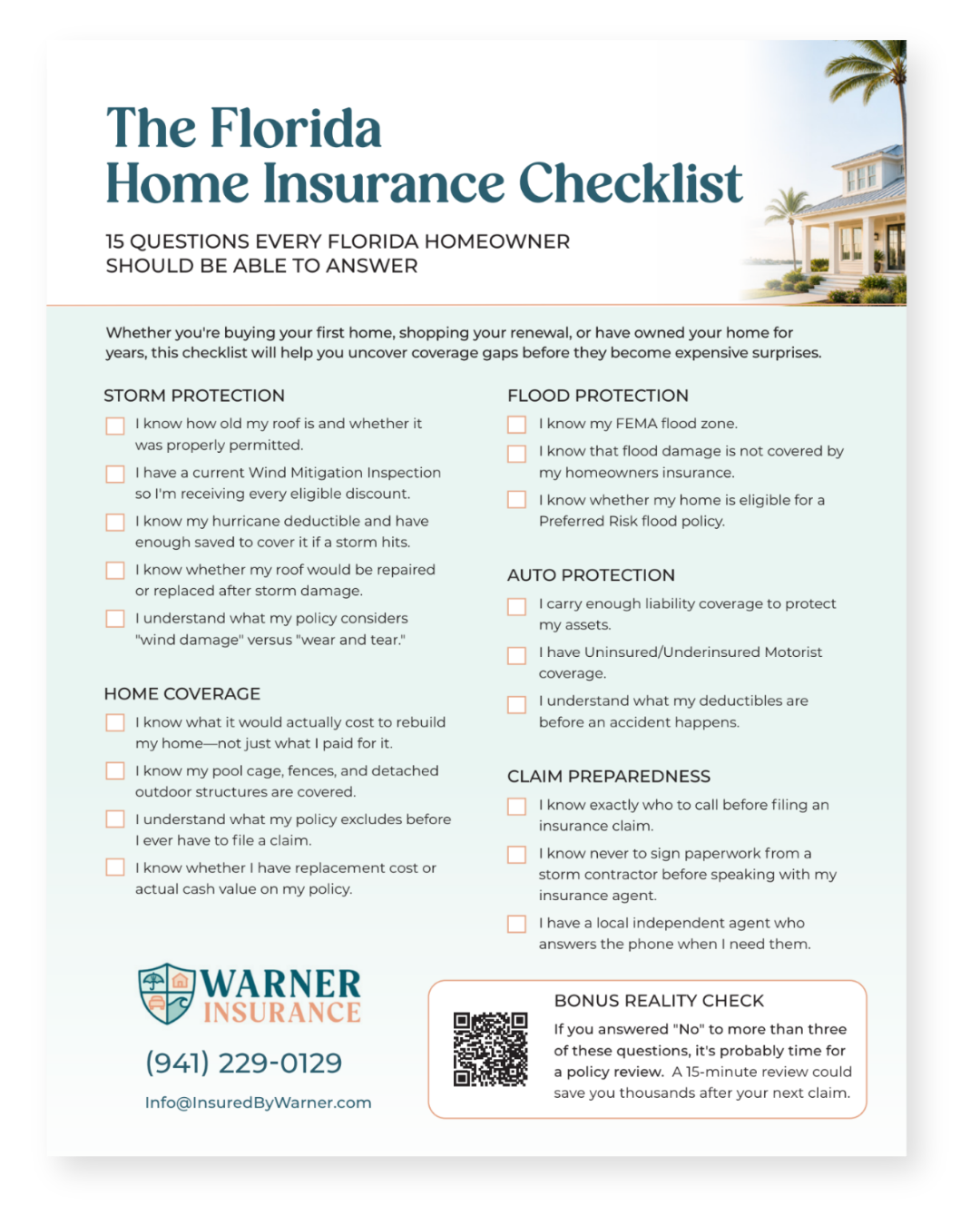
Learn the ins and outs with our free Florida Home Insurance Checklist.

Proud to be Florida-born.
Proud to welcome the Florida-bound.


I’m Ansley Warner—a Sunshine State lifer and passionately independent insurance agent. Basically, I know the ins and outs life here in Florida and do the hard work of shopping policies for you. For over seven years, I’ve helped clients find their place and their people, partnering with multiple carriers to provide maximum choice.
When we work together, you’ll get:
Total clarity on what your policies mean
Local expertise on Florida’s complicated market
Trusted partnership—no call centers, just real people

What Clients Love Most




It’s just different down here.

Storm exposure, flood requirements, strict roof age rules—we’ve got it all. Making sure you know all the facts and make all the right choices is Priority #1.
(AND WE DON’T JUST MEAN THE BEACHES.)
-
In Florida, high exposure to hurricanes, storm surge and wind damage requires homeowners to navigate a more specialized insurance landscape.
Some helpful things to keep in mind:
Hurricane deductibles are separate. Most Florida policies include a hurricane deductible—typically 2%, 5%, or 10% of the home's insured value—that applies only when a storm is officially declared a hurricane.
Flood damage isn't covered by homeowners insurance. Flooding from rising water requires a separate flood insurance policy, typically through the National Flood Insurance Program (NFIP) or a private insurer.
Roof rules are especially important. Roof age, condition and materials play a major role in underwriting, premiums and eligibility. Newer, hurricane-resistant roofs often qualify for discounts.
Wind Mitigation can lower costs. Homes with features like impact-resistant windows, reinforced roof-to-wall connections, hurricane shutters and fortified roofs may receive significant premium reductions after a wind mitigation inspection.
-
From a high water table to coastal storm surges, Florida faces one of the most complex flood risk environments in the U.S. While wind-driven rain and roof damage is generally covered by homeowner’s insurance, flooding from rising water tends to require separate flood insurance.
Some helpful things to keep in mind:
Flood risk extends beyond FEMA flood zones. A significant percentage of national flood claims come from properties outside high-risk FEMA flood zones. In Florida, intense rainfall and tropical systems can flood neighborhoods that have never experienced flooding before, making flood insurance valuable even for homes considered lower risk.
Flood risks can affect a variety of home-related costs. These include mortgage requirements, annual insurance costs, home resale value, and long-term affordability.
Modifications that could potentially offset cost. Homeowners can sometimes reduce flood losses and insurance costs by elevating utilities and HVAC equipment, installing flood vents, using water-resistant building materials and improving site drainage
-
Wind Mitigation credits are insurance discounts that reward homeowners for making their homes more resistant to hurricane and high-wind damage. Because stronger homes are less likely to suffer more costly losses, insurers can offer lower premiums.
To qualify, complete a Wind Mitigation inspection, during which a certified inspector evaluates features that help the home withstand hurricane-force winds. The insurer then uses the inspection report to determine eligible discounts.
Common Wind Mitigation features include:
Hurricane-rated roof coverings that meet modern building codes
Roof-to-wall connections (such as hurricane clips or straps) that help keep the roof attached during high winds
Secondary water resistance barriers beneath the roof covering to reduce water intrusion if shingles are lost
Impact-resistant windows and doors or approved hurricane shutters
Reinforced garage doors designed to resist high wind pressure
Roof shape, with hip roofs generally performing better than gable roofs in hurricanes
-
Florida law prohibits insurers from denying or refusing to renew a homeowners policy solely because a roof is less than 15 years old.
Once a roof reaches 15 years of age, the rules change:The insurer cannot automatically require roof replacement based only on age.
The homeowner has the right to obtain an inspection by an authorized inspector at their own expense.
If the inspection shows the roof has at least five years of remaining useful life, the insurer generally cannot deny or nonrenew coverage solely because of the roof's age.
In many cases, the condition of the roof matters more than its age. Insurers also evaluate:
Missing or damaged shingles
Signs of leaks or water intrusion
Roof material (asphalt, metal, tile, etc.)
Prior storm damage
Maintenance history
Compliance with modern Florida building codes
Granular loss


READY TO FEEL CONFIDENT IN YOUR COVERAGE?

Start with the right questions.
Whether you’re hunting for a new house or a new policy, my free Florida Home Insurance Checklist will help you understand what questions to ask before you buy or renew.

By submitting this form you agree to receive email communication from Warner Insurance. You can unsubscribe at any time. Messaging frequency may vary. We do not share your information without consent. Please visit our Privacy Policy page for more information.

© Copyright 2026 Warner Insurance